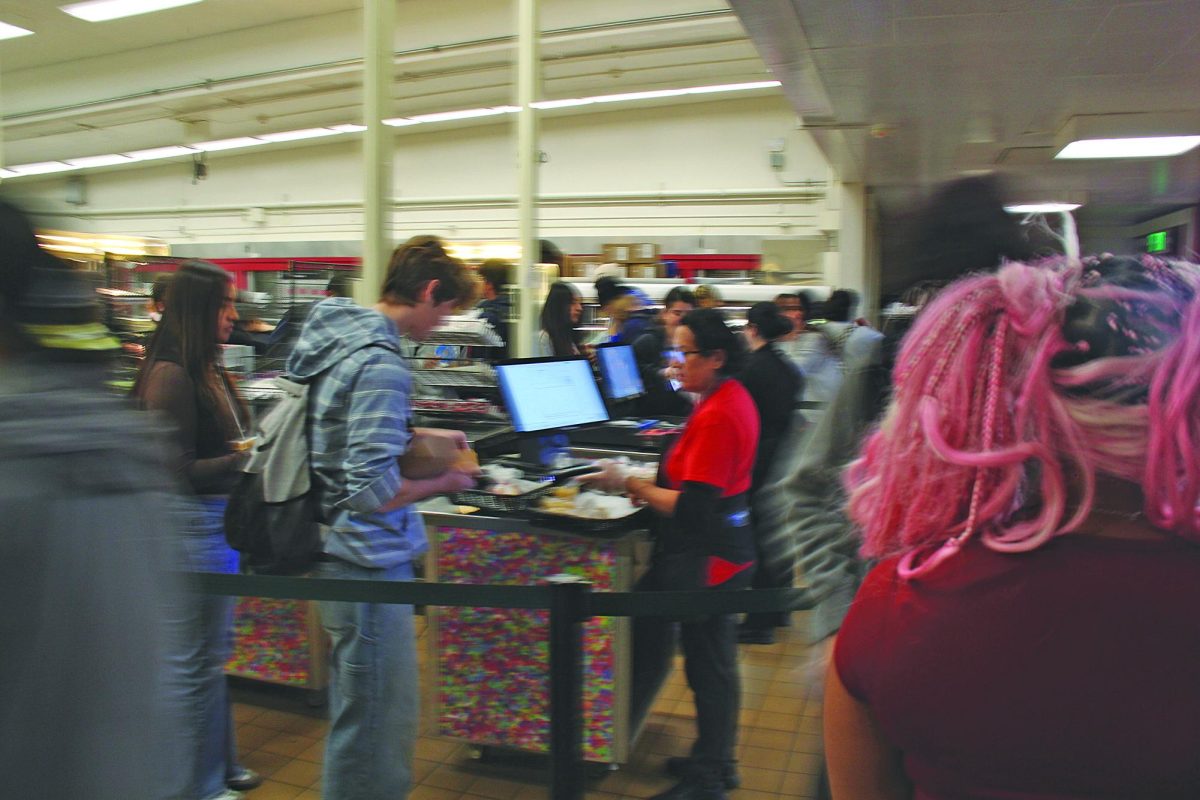
When the lunch bell rings, senior Isabel Valles heads straight for the cafeteria. She squeezes into a line that stretches to the door and barely moves. At the front, students fumble with school IDs, scanning them one at a time at a reader that doesn’t always work on the first try.
A policy implemented mid-school year requires students to scan their school IDs before they receive lunch. The system is designed to track how many students receive meals and to prevent anyone from being served twice, according to LAUSD.
But several students say the change has made the lunch line noticeably slower.
“I think it’s a hassle,” junior Mutakabbir Rahman said. “It takes way longer because you have to fiddle with your ID since sometimes it doesn’t scan correctly. Before, you’d just press a button, grab your food and go.”
For some students, the delays have changed whether they eat lunch at all.
“The lines barely move, and it makes me so impatient,” freshman Leianna Rosales said. “I even lose my appetite sometimes and just leave the line.”
The bottleneck is visible at the front of the line, according to senior Isabel Valles.
“Before the IDs, we would be in then out of the cafeteria, but now people are stopping the line to get their ID out of their backpack or to put their full code in,” Valles said.
From behind the counter, cafeteria staff see both the purpose and the problems.
“I get why they did it, to keep things organized, make the line move faster, but half of y’all forget your IDs anyway,” cafeteria staff member Sharlima Murshed said. “Honestly, it’s more stress than help before my first cup of coffee. The school wants to know who ate, who paid and who gets free or reduced lunch so the numbers stay right.”
Murshed said the staff learned about the change during a meeting with administration before it was rolled out.
“The administration explained the change, why it was being implemented and how to use the ID scanners,” she said.
The early days were the worst, Murshed said, though the system has improved as students learned the routine.
“It’s gotten a bit faster as everyone adjusted, but it’s still slower than before,” she said.
Still, Murshed said the new system is more accurate than the one it replaced.
“Even though it can slow the line down at times, it’s more reliable than relying on memory or manually entering names,” Murshed said. “If students are given clear expectations and the system is well-maintained, it can be effective. Patience on both sides, staff and students, also makes a big difference during the transition.”
“There was a period during COVID when the state didn’t have any policy that required students to enter a pin or use a card,” Cafeteria Manager Linda Maldonado said. “But now since that period has officially ended we’re implementing the ID policy, we haven’t gotten many complaints about the new system other than that it takes too long and wastes time.”
Rahman claims to have found workarounds to the new policy.
“If you wanna get past the ID system quickly you needa be there quickly,” said Rahman. “If your class is close to the cafeteria then that’s better. There’s also carts around the school that you can go to for lunch, but really the best way to get lunch is to get lucky and have a class close to a cart or the cafeteria. That’s only if you’re lucky enough to have a class that’s close.”
Between the ringing of the bell and the front of the line, Valles estimates she loses about 10 minutes of her lunch period to the scanner. On a good day, she gets her food with enough time to eat. On a bad day, she doesn’t.
This article originally appeared in the Early Spring 2026 print edition.








![S2 Ep.14 | [Tunin' In]](https://vnhsmirror.com/wp-content/uploads/2026/05/Screenshot-2026-05-13-at-1.26.18-PM-1200x675.png)