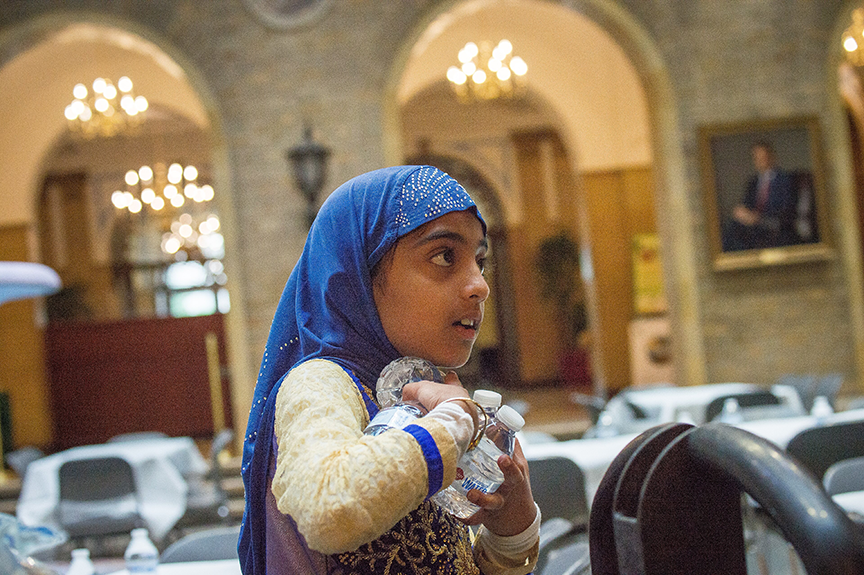
Every morning for 30 days, junior Fariz Khan woke up before dawn to eat, pray and begin another day of fasting. By the time first period started, the fast had already been going for hours.
For Muslims worldwide, Ramadan is a 29- to 30-day period of fasting from dawn to sunset along with prayer, reflection and community, and one of the Five Pillars of Islam.
Juniors Fariz Khan and Soliha Akhrorova both observed Ramadan this year, starting each day before dawn with suhoor, the pre-fast meal, followed by morning prayer.
The two students go through their school day fasting until sunset, when they can then break their fast at iftar, the evening meal that ends each day of fasting, and pray once again. For 30 days that was the schedule.
For Khan, Ramadan is primarily about self-reflection.
“I participate in Ramadan since it’s mandatory as a Muslim and personally I believe this time is best for self-reflection and overall becoming a better person and getting even closer to my faith,” Khan said.
For Akhrorova, the month is about patience and gratitude.
“I participate in Ramadan because it is an important part of my faith and helps me feel closer to God,” Akhrorova said. “It teaches me to have self control, patience and to be grateful for the things I have.”
Ramadan changes more than just meal schedules. Akhrorova said that beyond fasting, she also avoids listening to music.
“The main thing that’s different is that I don’t eat or drink during the day, but I also avoid music because it is said not to listen to music during the month of Ramadan,” Akhrorova said.
For Khan, Ramadan means spending more time at the mosque than usual.
“During Ramadan I pray at the mosque more than I would normally, especially at night,” Khan said.
The fast takes a physical toll. The physical effects are hard to ignore during school, Akhrorova said.
“Since I am not eating or drinking during school, it sometimes makes me feel tired and a little less focused in class,” Akhrorova said.
The impact extends beyond the school day, Khan said.
“It affects my school life by limiting my time on schoolwork and studying since I must allocate time to praying and attending the mosque and prepping for iftar,” Khan said. “My sleep is also affected since I have to wake up early in the morning for suhoor and prayer.”
It isn’t only their academics that are affected, but their social life as well.
For Akhrorova, her friends are respectful of her practice.
“I do tell my friends about my fasting everyday and they try to be mindful by not eating or drinking directly in front of me,” Akhrorova said.
The same awareness holds among Khan’s friends.
“Since many of my friends are familiar with my fasting they are aware and used to it,” Khan said. “Sometimes they do apologize for offering me food or are surprised I can’t drink water either.”
The community here at Van Nuys High School is extremely supportive and these students are able to freely express themselves and their religion.
Observing Ramadan at Van Nuys High School has felt natural rather than isolating, Khan said.
“I feel as though the act of fasting and the month of Ramadan has been normalized and many are familiar with it as a holy month of Muslims at which they fast,” Khan said. “I’m pretty comfortable expressing the fact I am fasting and participating in Ramadan.”








![S2 Ep.14 | [Tunin' In]](https://vnhsmirror.com/wp-content/uploads/2026/05/Screenshot-2026-05-13-at-1.26.18-PM-1200x675.png)