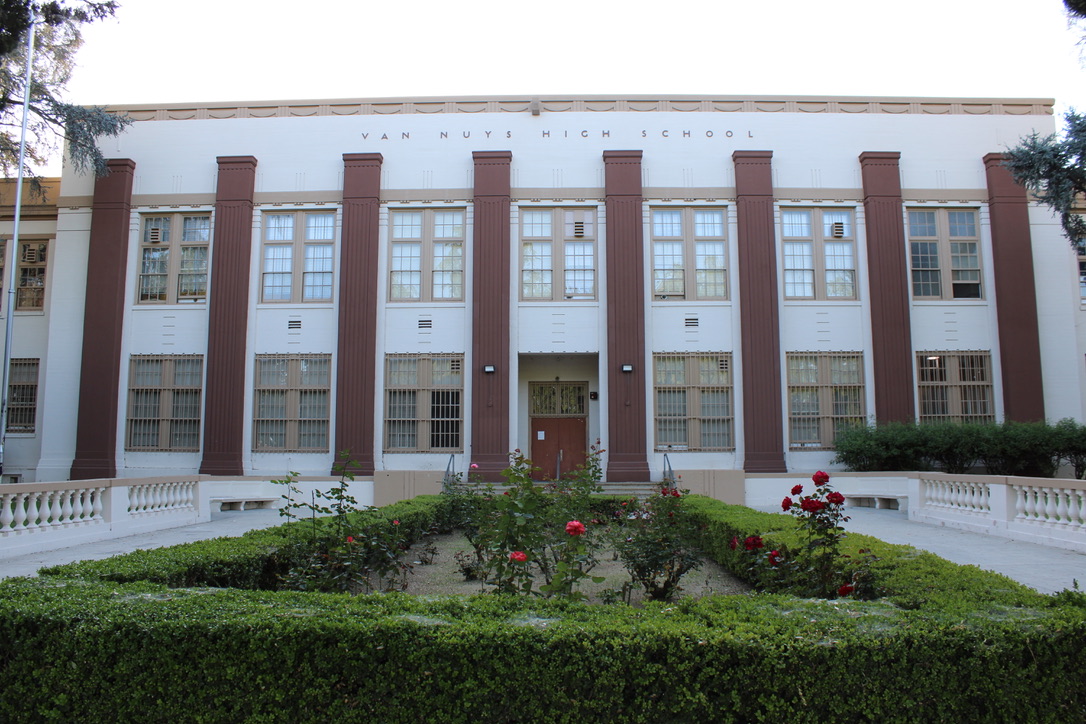
Van Nuys High School, located in Los Angeles, carries a label called PHBAO. This label is at the center of a federal lawsuit that could affect the school’s funding and staff.
PHBAO stands for Predominantly Hispanic, Black, Asian or other Non-Anglo. LAUSD decides which schools receive the PHBAO label based on who lives in the attendance zone, not who attends the school. It applies to areas where 70% or more of the surrounding population is non-white. Approximately 90% of LAUSD schools are labeled PHBAO.
Schools labeled PHBAO receive supplemental funding, smaller classes and four extra priority points when applying to magnets and require parent-teacher conferences. They maintain a student-teacher ratio of 25-to-1, while non-PHBAO schools have a 34-to-1 ratio, reducing class sizes by about 5.5 students.
According to the LAUSD’s school list, Van Nuys High School is considered PHBAO. Benefits currently given to PHBAO schools could be removed if the lawsuit succeeds, potentially resulting in major changes.
The 1776 Project Foundation filed the lawsuit in January 2026. It is a conservative education non-profit created by the 1776 Project PAC, led by president Aidan Buzzetti. The group aims to support school board candidates and oppose diversity, equity and inclusion (DEI) programs.
The lawsuit argues that LAUSD is discriminating against Caucasian students and violating the 14th amendment, which guarantees equal treatment under the law. The Civil Rights Act of 1964 states that schools receiving federal funding cannot discriminate based on race. The lawsuit also cites California’s Proposition 209, a state law approved by voters in 1996 that bans racial preferences in public education.
The lawsuit seeks to end race-based funding that favors schools with large minority populations, alleging discrimination against White and Middle-Eastern students. If successful, the court could issue a permanent injunction preventing LAUSD from using PHBAO in funding, staffing or admissions decisions. One member of the group is a parent whose children attended a non-PHBAO school and was denied magnet admission after not receiving the four PHBAO priority points.
On Feb. 19, the Department of Justice asked to intervene in the federal lawsuit to join the plaintiffs’ side. Intervening allows a third party to join a case when it believes the matter is of “general public importance.”
“Treating Americans equally is not a suggestion — it is a core constitutional guarantee that educational institutions must follow,” Attorney General Pamela Bondi said.
The judge has not yet ruled on the motion, meaning the request is still pending.
LAUSD said in its only public statement that it “remains firmly committed to ensuring all students have meaningful access to services and enriching educational opportunities.” The district said it cannot comment further on pending litigation.
PHBAO has been a part of the district’s integration program since 1978. The policy originated in the 1970s after a case called Crawford v. Board of Education found that LAUSD schools were segregated by race.
“Crawford was a student who was a minor and she was not white,” social studies teacher Mr. Robert Docter said. “It was her and other minority students versus the Board of Education of Los Angeles.”
The court ordered the district to desegregate, meaning to end racial separation and provide equal resources to students. PHBAO became part of how LAUSD followed that order.
According to Ms. Aditi Doshi, who teaches AP African American Studies, Crawford v. Board of Education was not the only important case connected to the policy.
“Policies like PHBAO were created as part of a larger effort throughout the country after the Brown v. Board decision in 1954 to desegregate public schools,” she said. “In the South, much of that desegregation was enforced by the federal government because a lot of the southern schools refused to desegregate. But in northern communities and western communities like ours, where the segregation was less clear, it was de facto segregation as opposed to desegregation, meaning it wasn’t enforced by the law.”
Docter explained that while Brown v. Board of Education and Crawford v. Board of Education shared the goal of desegregating schools, their roles were different.
Brown v. Board introduced the push to desegregate schools, while Crawford v. Board focused on enforcing desegregation in Los Angeles.
As a result of this, PHABO was created.
“It was an effort to create deliberately diverse schools and also an effort to allow students who lived in communities where their schools have not received financial investment for generations to attend high quality academic programs in any part of the city they wanted,” Doshi said.
Some people defend PHBAO because they believe the conditions it was created to address still exist. A study from the UCLA Civil Rights Project found that the percentage of intensely segregated schools in Los Angeles grew from 49.2% to 76.5% between 1988 and 2022.
According to EdSource, UCLA professor Tyrone Howard said the lawsuit “starts a conversation that’s really not based on real data and evidence.”
“Before any decision would be made with regards to the current functioning of our magnet programs, I think you’d really need to take a look at that data and examine to what extent educational inequalities are still present in our district,” Doshi said. “I will say that because part of the magnet program’s goal is to create purposely diverse schools, if you are not a student of color, it doesn’t necessarily harm you with access. If schools are trying to create purposely diverse populations, that includes white students.”
Supporters of the lawsuit see the issue differently. They argue that a policy created decades ago to fight racial discrimination has itself become discriminatory.
“PHBAO schools also want white students because they’re trying to create purposely diverse schools. The magnet system was never set up to be like, ‘Well you’re a PHBAO student, therefore you automatically gain entry to a magnet school,’” Doshi said. “There are a lot of other factors involved, but I think you really have to take a look at the data.”
Students at Van Nuys High say they don’t notice much impact in their day-to-day lives.
“I didn’t know about PHBAO until the PHBAO parent conference night,” freshman Gabrylle Estrada said.
Freshman Miriam Feslyan said that while she notices racial diversity around the school, she doesn’t see any clear advantages or disadvantages connected to the system.
“I can see Van Nuys as a PHBAO school,” freshman Jayana Harvey said. “Van Nuys doesn’t really have that many non-color students.”
The lawsuit argues that some schools receive smaller class sizes while others don’t based on race. Feslyn said that feels unfair.
“I feel like that’s very unfair because why would race matter in a school?” Feslyn said. “As long as there are students in the school, they should be getting the same amount of essential needs for their educational purposes.”
Harvey also shares this sentiment.
“I feel like all of us should have equal class sizes,” Harvey said. “Class size should be the same for all of us because it puts us into a situation that we didn’t ask for based on our race.”
Even though the lawsuit could affect funding at schools like Van Nuys, students interviewed said they believe resources should be distributed equally.
“I believe all schools should get the same amount,” Estrada said. “We shouldn’t limit things to just students of color.”
Harvey echoes this opinion.
“All schools should be getting the same amount. Our education, no matter who we are or what we look like, should all be the same,” Harvey said. “At the end of the day, we are the future adults. Why would you prioritize a specific type of group when you could give everyone the same resources?”
As the lawsuit over PHBAO continues, schools like Van Nuys High School sit in the middle of the debate. The policy was originally designed to address segregation and unequal resources, but students today are still trying to understand what fairness in education should look like. While courts decide the future for PHBAO, students continue to consider how those decisions may affect their schools.