

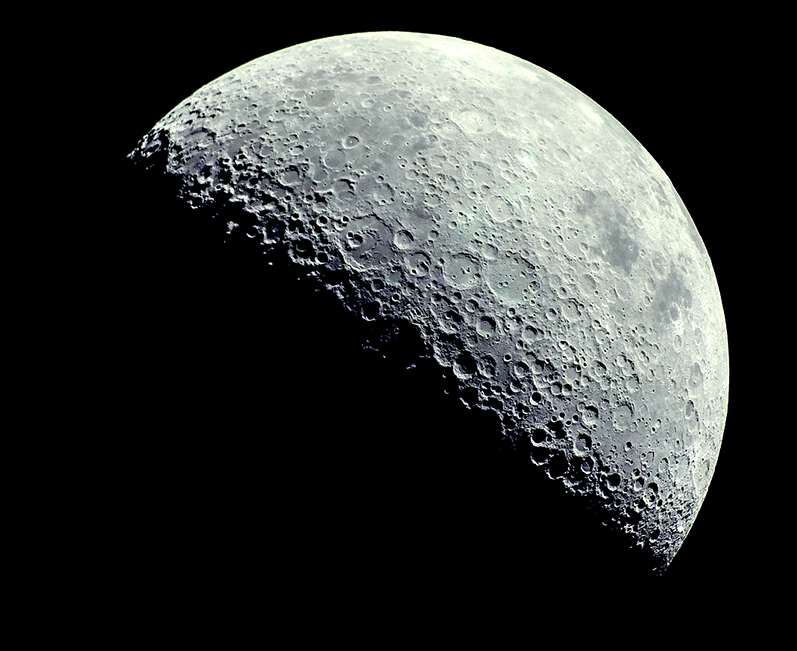

As early as April, 2026 four astronauts will strap into a spacecraft, loop around the moon and return to Earth after 10 days in deep space. No human crew has traveled that far in more than half a century.
NASA’s Artemis II crew includes Reid Wiseman, the commander; Victor Glover, the pilot; Christina Koch, the mission specialist; and Jeremy Hansen, also a mission specialist.
Their 10-day flight around the Moon could launch anytime between now and April if everything is on schedule.
“Judging with how complicated rockets are, I don’t think the mission will happen on time,” said freshman Josiah Ice. “It’s pretty common for things like space missions to be delayed because of safety reasons, there’s plenty that can go wrong with a mission like this.”
At its core, the mission is a test of NASA’s Space Launch System (SLS) rocket and the Orion spacecraft, the agency’s deep-space crew vehicle.
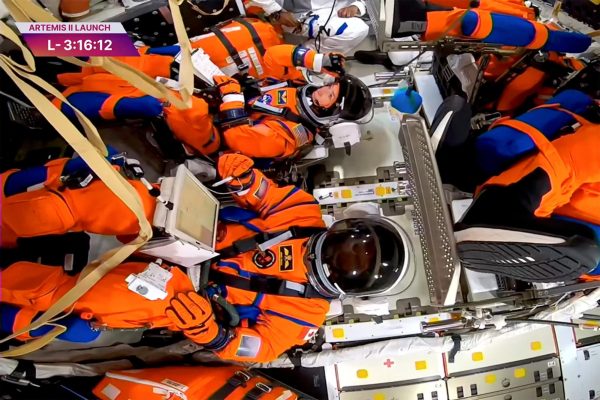
For students interested in aerospace or medicine, the experiments aboard Artemis II show how the two fields are converging.
Freshman Ayden Argueta explains why students should care about this mission.
“It’s pretty cool that the two are closely related to each other, especially with a space mission,” Argueta said. “Any high school student who wants a career in STEM, aerospace or medicine should definitely pay attention to a mission like this to keep with the current technology and practices we have.”
The mission will also make history. Glover will become the first person of color on a lunar mission, Koch will be the first woman to travel beyond low Earth orbit. Hansen will be the first non-American on a mission to the Moon.
During the mission, Orion’s life support and temperature control systems will be tested. But the crew’s own health is the real experiment.
Five studies will track the crew’s health throughout the mission, targeting the biggest unknowns of deep-space travel: radiation exposure, immune system changes and the physical and mental toll of isolation.
None of the research stays in orbit. Each experiment has potential applications in medicine on Earth.
Outside Earth’s magnetic field, space radiation is one of the greatest threats to the human body. Orion will carry six radiation sensors, and each astronaut will wear dosimeters to track individual exposure levels.
Scientists will also analyze the crew’s immune systems. Blood and saliva samples collected before, during and after the mission should show how deep-space radiation, isolation and stress affect immune function.
One focus is the reactivation of dormant viruses, something observed on the International Space Station.
A third study, the Artemis Research for Crew Health and Readiness (ARCHeR) investigation, will use wearable wrist sensors to monitor sleep patterns, stress levels, cognitive performance and teamwork.
If isolation and confinement change how astronauts think and sleep, the data could also inform how researchers study stress on Earth.
Perhaps the most striking experiment involves “organ-on-a-chip” technology. As part of the AVATAR investigation (A Virtual Astronaut Tissue Analog Response), thumb-sized organ chips containing bone marrow cells from each astronaut will travel aboard Orion.
Researchers will use the chips to study how deep-space stressors, such as microgravity and radiation, affect human tissue at the cellular level.
“There’s a lot of stuff that happens in space,” freshman Joseph Andrade said. “Maybe we could find something out there that could help us advance health technologies further. I think it’ll be a huge help to those who struggle with stress or just people who are generally anxious.”
These chips will be traveling a quarter-million-miles from the bodies they came from will eventually come back home and unlock more information for researchers to better understand the mysteries of the human body.
An abridged version of this article appeared in the Early Spring print edition of VNHS Mirror.