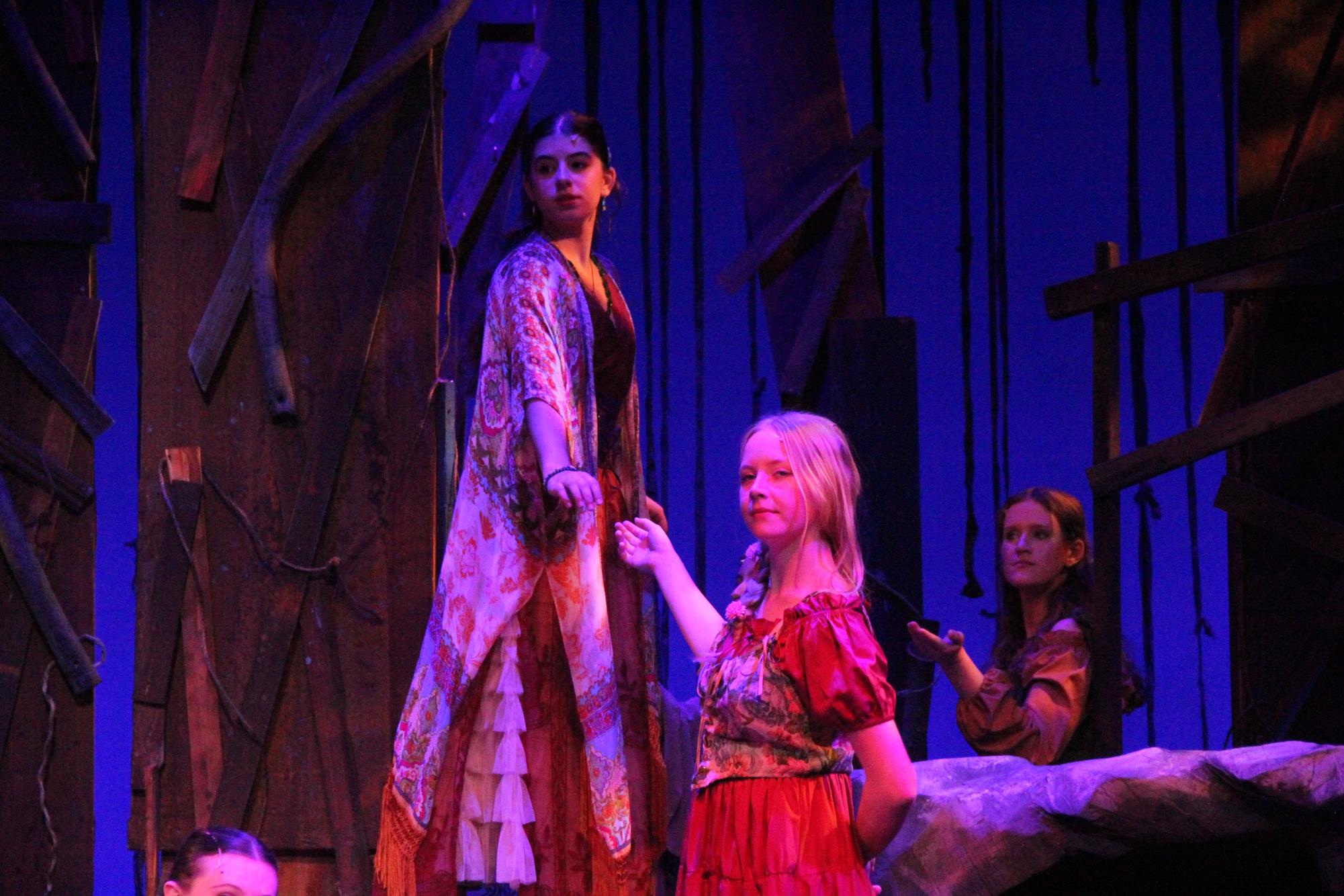


Nervous actors crowd the hallway outside Room 303, scripts clutched in sweaty hands. Inside, director Mr. Justin Baldridge sits with his clipboard ready to cast the fall play, “A Midsummer Night’s Dream” — but not Shakespeare’s version. In this production, Athenian nobles become Capitol elites from “The Hunger Games,” and the enchanted forest transforms into a deadly arena.
For these students, being chosen to fight to the death in the arena, they’re auditioning for Room 303 callbacks, where just one performance of a scene can determine the role they will perform for this upcoming season.
The production opened Oct. 16 for a four-night run, but few dare to transform Shakespeare into already known universes like the “Hunger Games” franchise. By setting the romantic comedy in Panem’s Capitol and arena, the Wolfpack Theatre Company joins a long tradition of radical Shakespeare adaptations. The bold choice asks audiences to see familiar themes of power, love and chaos through a dystopian lens, proving that Shakespeare’s 400-year-old comedy still speaks to contemporary anxieties about authority and survival.
After acting through multiple sides of dialogue and giggling through mishaps and big dramatic choices, the actors begin the anticipation for the cast list, which will come out the next day. The anxiety, excitement, dread and hope all comes to a head when director Justin Baldridge posts the cast list. Rehearsals will begin the next week.
Junior Maddy Mills recounts how she felt when she was cast as one of the leading young lovers of the play.
“I was really shocked because I’ve never felt like my acting is as strong as my singing abilities,” Mills said. “I was just really excited and grateful for the opportunity, and excited to work on a new thing I’ve never experienced before.”
Before tackling the blocking of the character’s movements, Shakespeare’s text must be decoded, which can be a very daunting task to the average actor.
Freshman Trystan Tabbador talks about learning how to decipher Shakespeare after some trouble with the complicated terms of Shakespearian English.
“It was definitely difficult at first, getting to learn all the differences between Shakespearean English and modern English was confusing,” Tabbador said. “After some practice, research and help from Mr. Baldridge, I started to understand it more. It’s been hard but throughout the past weeks, I have learned to understand the importance of the dialogue and language of the show.”
The difficulty doesn’t stop at just dramaturgy. The students have been adapting to the new block schedule, which has affected the rehearsal process both positively and negatively. Now, less time has to be spent in after-school rehearsals, since every other day there will be dedicated time during school hours. However, the long hours spent inside the auditorium can lead to fatigued performances and drained acting.
Senior Brianne Tolentino, who plays Hermia in the show, finds that the block schedule helped the rehearsal process go a lot more smoothly.
“The block schedule definitely helped a lot for the rehearsal process,” Tolentino said. “Since the block schedule allowed us to have production as a class period, we didn’t have to stay after school everyday and also had less Saturday rehearsals. With not having to stay so late everyday and especially during the week before the show, I felt more rested so I was able to put more energy into my performance.”
Soon enough, the dreaded Tech Week arrived — fast paced through full run-throughs, notes from the director up to three pages long, jumping from one light cue to the next. Students prepared for their schoolwork to take the backseat amidst the long hours of daily rehearsal, and actors struggled with not being able to call for “line?”
But it wasn’t just the acting that brought the fictional world of Panem and the Capitol to life. The tech team created the entire dystopian atmosphere through lights, sound, costumes and every detail in between — the multi-colored flowers tying up the covey’s hair, the quick choreographed scene changes flashing before your eyes and the grey and silver rock formations rising from downstage – in just a few weeks.
Following the success of the theatre department’s middle school workshops, which invited seventh and eighth graders to join the cast and crew in the afternoon to partake in acting, costuming, lighting and more, this year saw a noticeable influx of freshmen, particularly on the tech side of the production.
Freshman Liana Olvera, working with the props/run crew department, was nervous but eager to start contributing behind the scenes, especially in a new environment.
“It’s kinda scary and exciting at the same time,” Olvera said. “But everyone is really nice and I do have some friends, so it’s nice to be able to hang out with them. I hope to see myself become more confident and get to know people in the department better outside of the people in props.”
Olvera has found a sense of community in the collaborative energy of working on the props team. The team spends time patiently creating design ideas and takes time to joke with each other while working. She’s learned that theatre is just as much about teamwork behind the scenes as it is about what happens on stage.
“It’s really cool to see how all these small pieces come together to make the story feel real,” Olvera said. “I’m excited to keep learning and help bring the show to life.”
On the opposite side of the auditorium lies the tech booth where senior Jan Soriano, the Production Stage Manager (PSM) of the show, controls the production’s technical elements. Wearing a headset and following the script, Soriano calls cues for lights and sound, keeps the entire cast and crew focused and organized and ensures that every element of the production comes together seamlessly.
“Being PSM for ‘A Midsummer Night’s Dream’ was both overwhelming, but incredibly rewarding,” Soriano said. “There were definitely many challenges I had to overcome. But I loved being able to support the entire cast and crew through every stage of the production.”
With the sheer amount of time spent with the same people, the team is bound to become a tight-knit group, but it’s important to keep the professional setting in mind. Balancing a professional mindset with joking around and casual conversations can be a difficult feat.
“It’s definitely a challenge and hard to balance so, I try to lead with respect and empathy, making sure I listen to others and treat them as equals,” Soriano said. “At the same time, I’ve learned that it’s okay to assert myself when necessary and be direct in a professional way. Having communication skills has helped me manage those two things effectively.”
Senior Melissa Ocegueda, one of Soriano’s close friends, took charge as the Assistant Director of the show. Though both have important leadership roles, their powers lay in different areas of the production.
Ocegueda’s job is to work closely with the actors and to give another perspective to staging and direction.
With a well-known show like Midsummer, there are many examples of different productions that could be used to guide ideas for staging and direction. But adding the setting of Hunger Games to the mix elevates the show to a whole new level.
And while this does add complexity to the staging process, Ocegueda believes integrating another work isn’t as difficult as it may seem.
“To be completely honest, if you’re looking overall at the plot of the show when adding the Hunger Games element, it’s not very different from the original. It’s just a lot of word swapping,” Ocegueda said. “A lot of the stuff to help guide the purpose of the setting really has to do with costumes, props and lighting to ensure that the theme is still shining through.”
The show had an amazing four-day run, signaling the successful end of the Wolf Pack Theatre Company’s first production of the school year. On opening night, the auditorium filled with families and students eager to see how Shakespeare’s fairies and lovers would navigate Panem’s deadly games.
When the lights dimmed to the opening soundtrack of the Hunger Games, weeks of rehearsals transformed into an immersive fantasy world. One with a comedic theatre troupe turned district dwellers, Athenians to powerful Capital elites and an enchanted forest to an arena where love instead of death was the ultimate prize.
Until next semester’s production of “Chicago,” Happy Hunger Games, and may the odds be ever in your favor.
This article originally appeared in the Fall 2025 print edition.