

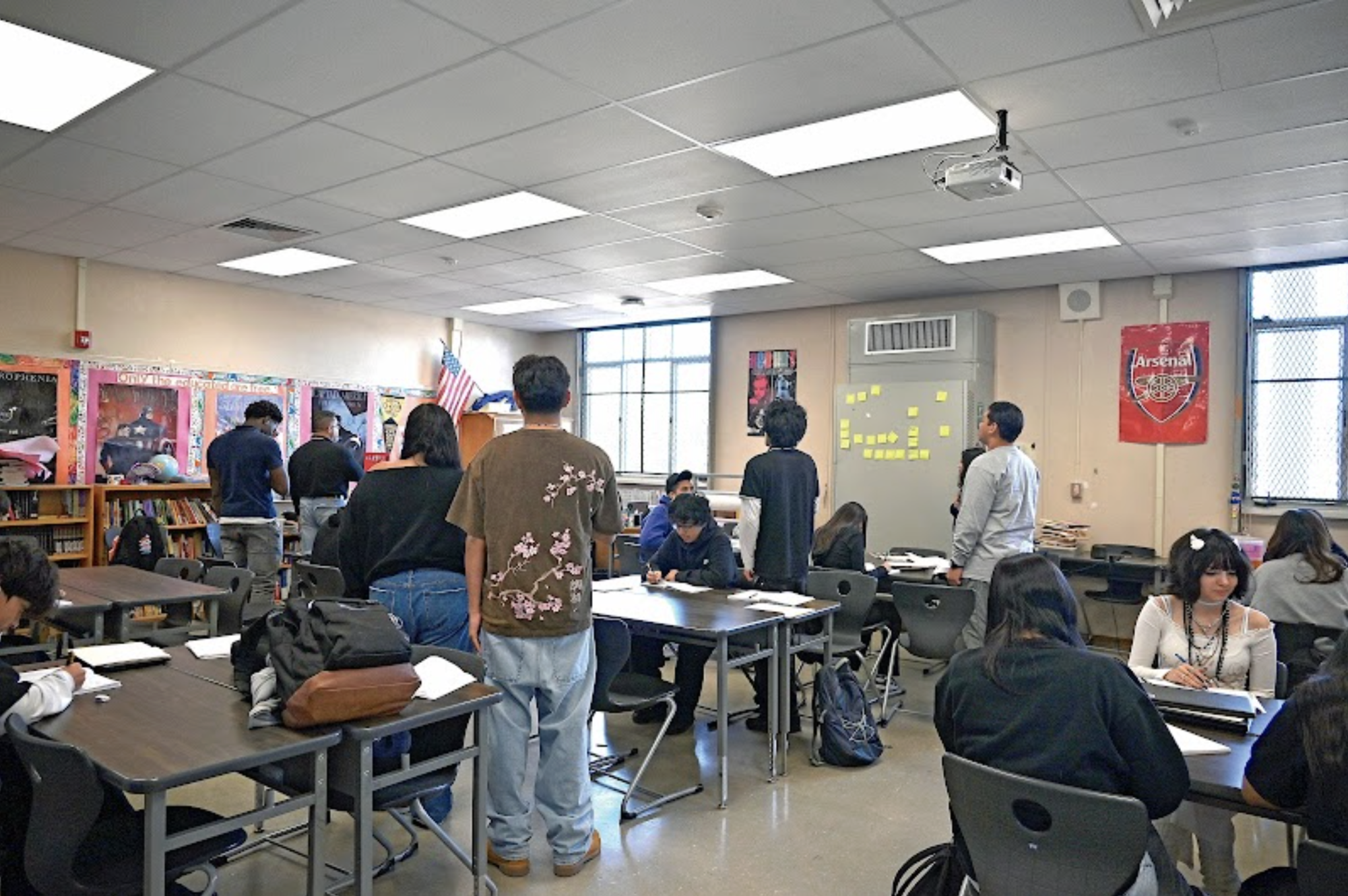

When the voice on the PA asks students to rise for the Pledge of Allegiance, junior Lucea Barte hesitates. Around her in first-period class, most students stay seated, scrolling through phones, conversations unbroken.
Unsure whether to follow the crowd or stand up, Barte stays quiet and watches.
Across the campus, the Pledge of Allegiance has become a daily test of where students, and their teachers, actually stand. A survey of 12 teachers found that only two require students to rise. The rest encourage it, ignore it or actively oppose it.
With no consistent schoolwide expectation and a political climate that has left many students disillusioned, what was once a routine exercise has turned into a quiet act of choice.
“I encourage it out of respect,” science teacher Tracey Kim said. “I can understand why they don’t stand.”
But not all teachers take the same approach. Some believe enforcement is not optional.
Math teacher Aim Pederrson said they believe the law requires teachers to enforce the pledge.
“It’s actually a federal law that students have to stand for the Pledge of Allegiance, so I enforce it,” they said. “I also believe it is respectful for our country.”
Federal law says the opposite. In West Virginia State Board of Education v. Barnette (1943), the U.S. The Supreme Court ruled that students cannot be required to salute the flag or recite the pledge. The decision has stood for more than 80 years. Still, students say the rule is not always explained clearly on campus.
Other teachers, like history teacher Jonathan Mitchell, believe students should stand but do not require it.
“I think you should stand for it,” Mr. Mitchell said. “Like at a baseball game, you should definitely stand. I believe you should show respect. But I don’t enforce it. I don’t make them stand. I should, but I don’t.”
On the other end of the spectrum, history teacher Jacob Ferrin doesn’t ask students to participate at all.
“I don’t believe in nationalism of any kind or of any shape, and I don’t believe in forcing students to pledge to a flag or a country,” he said.
But Barte believes that sometimes it’s just a matter of conformity.
“A lot of students stand just because everyone else does,” Barte said. “It usually depends on how strict the teacher is. I am forced to stand by my teacher, but if I had the option, I wouldn’t. If we don’t stand, they stop the pledge and tell us to get up. They say it’s the law and that we have to.”
She said students who remain seated are addressed in front of the class.
“It’s not like we get detention,” Barte said. “But they’ll call you out.”
This inconsistency isn’t lost on students. Junior Maddy Mills said the mixed messages from teachers leave students unsure of their rights.
“Some teachers make it seem like standing is mandatory, while others don’t mention it at all,” Mills said. “That inconsistency makes students unsure of what they’re allowed to do.”
But the reason students stay seated isn’t only about confusion. For some the choice is political.
At Van Nuys High School, where a majority of students are students of color, national politics can feel personal. According to LAUSD Unified, Van Nuys High School’s student body is approximately 70.2% Latino, 11.6% White and 8.9% Asian.
“I don’t stand because I don’t feel represented by the government right now,” junior Leo Gragnani said. “With everything going on politically and economically, it doesn’t feel right to participate.”
“With Trump back in office and things like ICE deportations still happening, I don’t feel comfortable standing for the pledge,” Gragnani said. “It talks about liberty and justice for all, but I don’t think that’s what everyone is experiencing.”
The pledge still plays over the PA twice a week as it has for years. What has changed is how students respond to it.
“We play it because it is put in our schedule to play it,” junior Raul Mendez, who participates in the morning announcements, said. “I don’t think it makes too much of a difference because we only play it twice a week. I do understand that it is a symbol of respect, and that’s why we follow along.”
Back in first period, Barte sits at her desk as the pledge ends. She didn’t stand. She’s still not sure she’s supposed to.
“When it’s over, we just go back to class like normal,” Barte said. “But sometimes I’m still thinking about it.”
For Barte, the decision feels bigger than just standing up or sitting down.
“It shouldn’t be confusing,” she said. “I just want to know what my rights actually are.”
This article originally appeared in the Early Spring 2026 print edition.